Data quality refers to the degree to which data meet the requirements of the application. This involves the identification, measurement, monitoring, and improvement of the potential data quality issues at each stage of the data lifecycle.
Specialized positions should be responsible for the quality of performance data.
Quantitative evaluation of performance data quality is an important aspect of data quality management, and evaluation dimensions may include: data completeness, data timeliness, data accuracy, data consistency, data standardization, data accessibility, etc.
Data quality management and data quality evaluation indicators
- Data integrity should measure the degree to which data is fully assigned according to rules.
- Data timeliness should measure the accuracy of data over time, including the timeliness of data acquisition and the degree to which data conforms to the current business temporal logic.
- Data accuracy should measure the degree to which data represents the true value of the entity it describes.
- Data consistency should measure the degree to which data does not conflict with data used in other specific contexts.
- Data standardization should measure the degree to which data conforms to defined data standards, data models, business rules, metadata, and other specifications.
- Data accessibility should measure the degree to which data can be accessed and used.
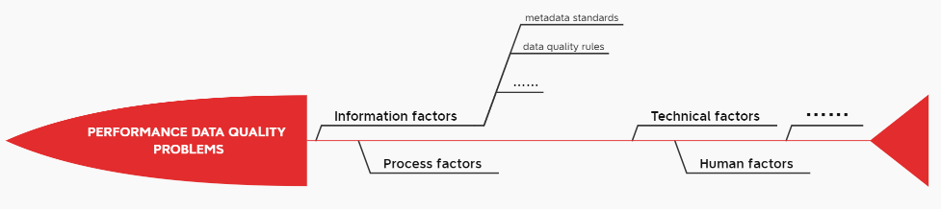
It is necessary to analyze the causes of issues pertaining to performance data quality. These causes could include information, process, technical and personnel reasons.
- Information factors refer to anomalies in data standardization, including metadata standards, data quality rules, and frequency of changes.
- Process factors refer to improper setting of information system processing and manual operation processes, including data creation, transmission, loading, use, maintenance, and auditing processes.
- Technical factors refer to anomalies in various technical aspects of data processing, including improper design of data verification rules, improper access to data sources, limited data storage capacity, etc., mainly involving data creation, data acquisition, data transmission, data loading, data usage, data maintenance, and other aspects.
- Human factors refer to insufficient personnel and management mechanisms, including lack of personnel training, unclear data responsible persons, and insufficient incentive and feedback mechanisms.